News
Aalborg University will send a robot to the Moon
Published online: 09.04.2026
News
Aalborg University will send a robot to the Moon
Published online: 09.04.2026
Aalborg University will send a robot to the Moon
News
Published online: 09.04.2026
News
Published online: 09.04.2026
By Kim Rathcke Jensen, AAU Communication and Public Affairs
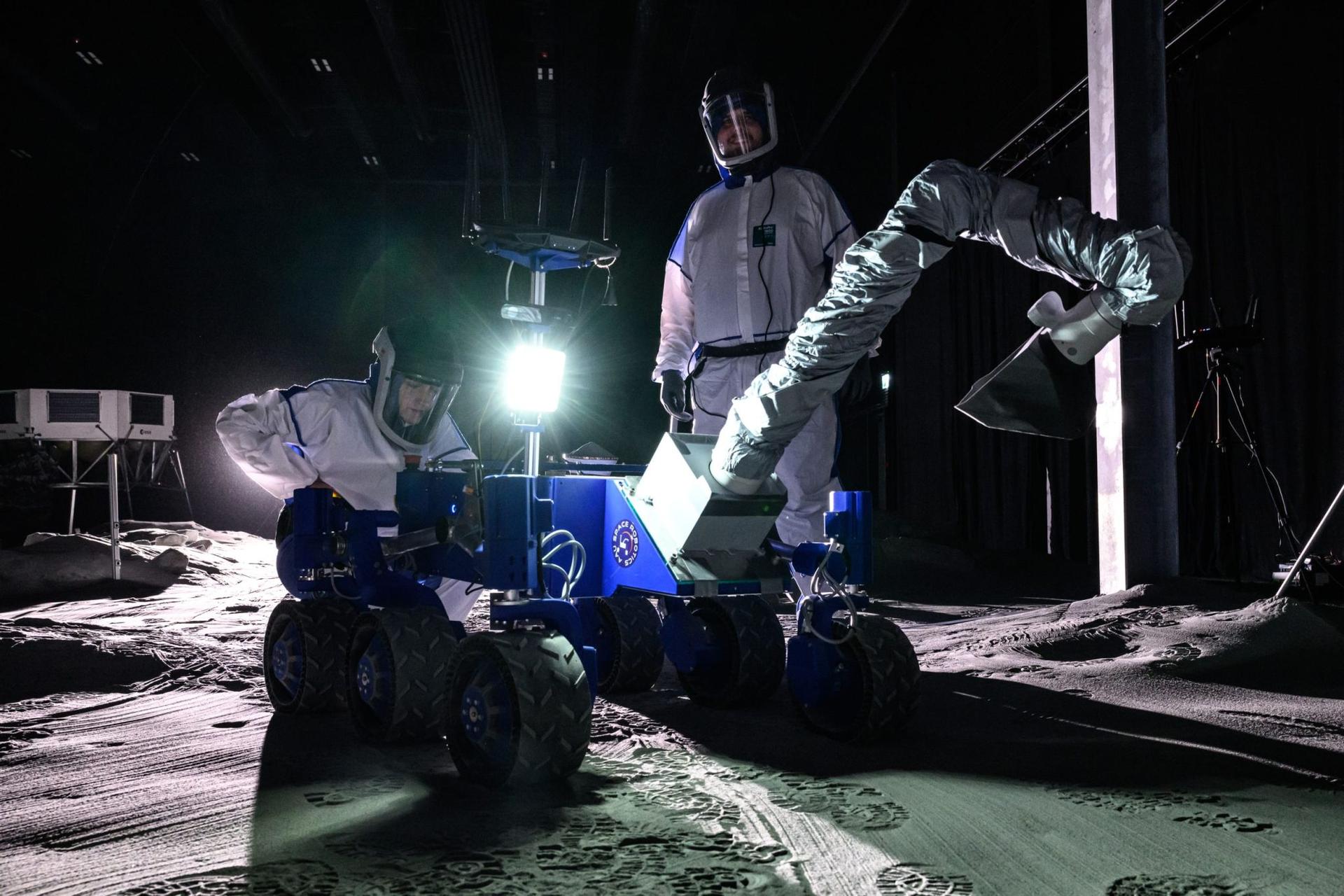
Photo: Simon Bøgh, Space Tech Center
The United States just sent four astronauts into orbit around the Moon. And the Americans want astronauts to walk on the surface of the Moon again.
They are not alone. Several other countries are also planning to travel to the Moon to establish bases.
But if people are to stay up there for a longer period of time, it requires more than crewed missions. It requires robots that can work independently and utilize the resources that already exist on the Moon.
"If we are to stay up there in a sustainable way, we cannot bring everything from Earth. We need to use the resources that are already on the Moon. And that requires robots," says Simon Bøgh, Associate Professor and Co-director of the Space Tech Center.
Aalborg University is thus working on sending a robot to the Moon in the next five to ten years. Researchers and students at AAU are currently getting the first prototype of the moon rover ready.
The robot must be able to drive autonomously in the harsh lunar environment and investigate, extract and handle the Moon's resources.
For example, water-ice that can be converted into oxygen. Or minerals and regolith, the porous layer on the surface that can be used as building materials for future lunar bases.
"We start by building and testing the technology here on Earth, but our ambition is to develop systems that will be sent to the Moon," says Simon Bøgh.
The first prototype is expected to be ready for testing on 1 May 2026. The robot will be tested in a simulated lunar landscape.
One of the most important things in the work is to ensure the robot is space-grade. This means, among other things, that all components, materials and systems must be designed to be able to survive the extreme conditions in space and during transport.
The moon rover must be able to operate in a vacuum. It will encounter strong radiation and temperatures ranging from approximately −170°C to +120°C. There will be lunar dust. And violent vibrations during rocket launch.
"You can't control a robot on the Moon with a joystick in real time. It must be able to make decisions itself with the help of artificial intelligence and we are also developing that," says Simon Bøgh.
"It’s not enough that the robot works in a laboratory. It must work in an environment where even small mistakes can cause the entire mission to fail," says Simon Bøgh.
The moon rover is also part of the students' work and classroom instruction at Aalborg University.
Since 2003, AAU has developed and launched several student-built CubeSats that have orbited the Earth.
Students and researchers at AAU also work closely with the European Space Agency. And AAU students have helped calculate the trajectory for the Danish Máni mission that will map the surface of the Moon in high resolution.
Moon rovers will be used, among other things, for mapping terrain, extracting resources and preparing areas for future bases.
The work at Aalborg University is an example of the type of technology that will be central in the coming years, where massive investments are being made in future space infrastructure and a presence on the Moon.
"Artemis II is an important step, but the next step will be to build an actual presence on the Moon. Robots play a crucial role because they can work continuously and in environments where humans can’t," says Simon Bøgh.
Fact Box: The race to the Moon
Hub for Space Technology
The current space technology cluster around Aalborg University comprises around 40 companies and start-ups employing more than 1,100 people.
North Jutland is the centre of Danish space technology, and Aalborg University is home to some of Europe’s most highly recognised researchers in the field. Read more in this report by IRIS Group.
Space technology research at Aalborg University dates back to the 1990s, when the university and North Jutland became a global powerhouse for antenna research, attracting global tech giants and mobile phone manufacturers.
As early as 2003, AAU students became the first in Denmark to send a student-built nanosatellite into orbit.
Today, the university’s space technology research is brought together in the Space Tech Center, where AAU develops the solutions of the future in satellites, robotics and space communications.