News
Student's semester project goes to the Moon
Published online: 17.12.2025
News
Student's semester project goes to the Moon
Published online: 17.12.2025
Student's semester project goes to the Moon
News
Published online: 17.12.2025
News
Published online: 17.12.2025
By Kim Rathcke Jensen, AAU Communication and Public Affairs
Translated by LeeAnn Iovanni
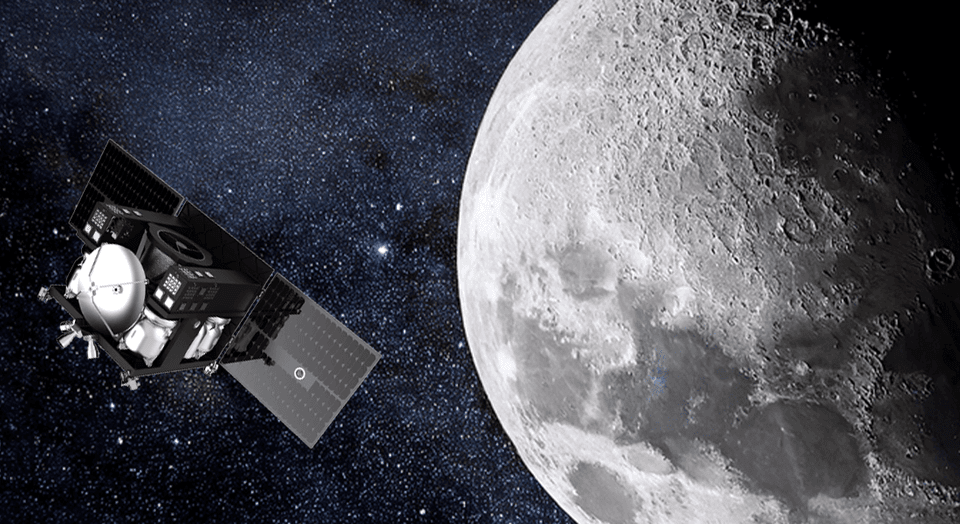
Denmark is going on a mission to the Moon. A Danish satellite will map the surface, making it possible for astronauts and robots to choose safe landing sites.
It is a milestone for Danish space travel and the first time that Denmark is leading a space mission outside of Earth’s orbit.
The total budget for the Máni mission is DKK 373 million, and it is a collaboration between Danish and European universities, research institutions and companies as well as ESA (the European Space Agency).
But three students from Aalborg University play a crucial role. They have done the calculations on the satellite's orbit around the Moon.
"It's a bit crazy. But it's fantastic that I can spend my study time on something that will be used in real life. And it's great that it's a Danish-led mission," says Jonas Jakobsen, who will complete his Master's degree in Electronic Systems in the summer of 2026.
Jonas, who is 24 years old, did the calculations as a semester project along with his two classmates, Rasmus Haupt Dybkjær and Lukas William Ninn Fasken.
"I talked to my supervisor about what we could do. And then he told me about this project about a mission to the Moon, which sounded incredibly exciting. Already then I thought I would really like to be involved in it, so Rasmus, Lukas and I wrote a project proposal," says Jonas.
The satellite is scheduled to be launched in 2029. After that, it is expected that the mission will last three years, during which it can deliver scientific results.
It is – of course – not so simple to send a satellite into orbit around the Moon. There were several requirements that the students had to meet.
The satellite’s path must allow it to take pictures of the surface from several angles. The sun has to be positioned in different ways and cast different shadows, so the images are much more detailed than just shooting from above.
Since the satellite cannot take pictures and send data back to Earth simultaneously, it is important to transmit at times with the least interference in taking pictures. Time in space is precious and must be used wisely.
The satellite must also be located so that it can send data back to Earth without filling up its internal storage.
And finally, there are the batteries that need to be recharged. The satellite’s orbit must allow it to use its solar cells and get the sun's rays to charge its batteries.
"We have simulated the movements of the Earth, Moon, Sun and satellite for three years, which is the minimum lifetime of the project. The three years gives us many variations in relation to the full moon, crescent moon, seasons on Earth and so on, so statistically we’re covered," says Jonas Jakobsen.
But isn't Jonas just a little nervous about calculation errors?
"I'm not nervous. We have good safety margins, and we’re working with people who have a lot of experience in the field. We’ve done countless simulations," says Jonas Jakobsen.
Fact Box: The Máni missio